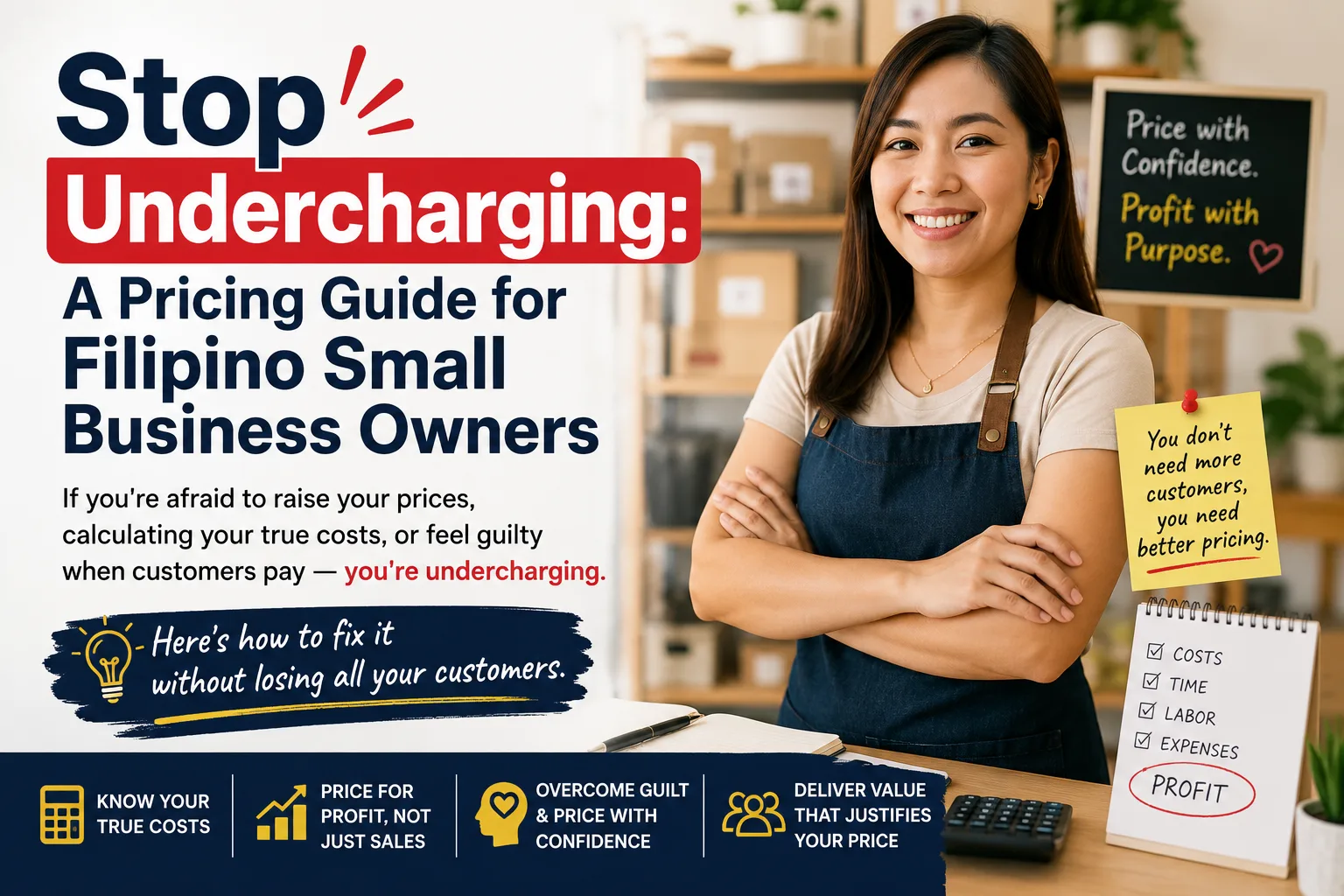
If there's one problem I see more than any other among Filipino small business owners, it's this: you're charging too little.
I'll prove it. Answer these honestly:
- Do you calculate your costs before setting prices — or just guess?
- Do you know your hourly rate — or have you never thought about it?
- When was the last time you raised your prices?
- Do you feel guilty when customers pay your prices?
- Do you offer discounts because you're afraid people won't buy?
If you answered "yes" to any of these, you're undercharging. And it's costing you more than you realize.
Let's talk about why Filipino small businesses undercharge — and how to fix it without losing all your customers.
Why Filipino Small Businesses Undercharge
Reason 1: "Sulit" Culture
Filipinos love a deal. Customers negotiate, ask for discounts, compare prices across 10 suppliers. Business owners, afraid of losing the sale, cave in and lower prices.
But here's the truth: customers who only buy on price will leave you for someone cheaper anyway. They're not loyal. They're not profitable. Stop competing for them.
Reason 2: Imposter Syndrome
"I'm just starting out." "I don't have enough experience." "Who am I to charge that much?"
Sound familiar? Imposter syndrome makes you price based on your insecurities instead of your value. The customer doesn't care about your experience level — they care about whether you can solve their problem.
Reason 3: Not Knowing the Numbers
Most small business owners don't actually know their costs. They price based on "what feels right" or "what competitors charge" — without calculating whether that price covers costs and leaves a profit.
If you don't know your costs, you can't price profitably. Period.
Reason 4: Fear of Losing Customers
"My customers will leave if I raise prices." Some will. Most won't. And the ones who stay will pay you more — meaning you can serve fewer customers and make the same (or more) money.
Reason 5: Comparison to Giants
You see SM Supermarket selling bread for ₱50 and think "I can't charge more than that." But SM buys flour by the truckload. You buy it by the sack. Your costs are different. Your value is different. Stop comparing.
The Real Cost of Undercharging
Undercharging isn't just "leaving money on the table." It actively harms your business:
- You can't afford to hire help → stuck doing everything yourself
- You can't invest in better equipment/marketing → stagnation
- You work 60+ hour weeks → burnout
- You resent your customers → bad service → fewer customers → lower prices → worse burnout
- You can't take time off → health suffers
- Your business stays small forever → you never reach your potential
Undercharging is a trap. The businesses that survive long-term are the ones that price profitably.
How to Price Your Products/Services (Step by Step)
Step 1: Calculate Your True Costs
Before you set prices, know exactly what it costs to deliver your product or service.
For product businesses:
Cost per unit = Materials + Labor + Packaging + Shipping + Transaction feesExample for a cake:
- Ingredients: ₱400
- Your labor (2 hours × ₱150/hour): ₱300
- Packaging (box, ribbon): ₱50
- GCash fee (1.5% of sale): ₱15
- Total cost: ₱765
If you sell that cake for ₱800, you're making ₱35 profit. That's not a business — that's a hobby that's slowly bankrupting you.
For service businesses:
Cost per hour = Desired monthly income ÷ billable hours per monthIf you want ₱30,000/month and can bill 80 hours (out of 160 work hours — the rest is admin, marketing, etc.):
- Your hourly cost: ₱30,000 ÷ 80 = ₱375/hour
If you charge ₱200/hour, you're losing money. Every hour.
Step 2: Add Your Profit Margin
Your price should cover costs PLUS profit. A common formula:
Price = Cost ÷ (1 - Desired profit margin)For a 40% profit margin on a ₱765 cake:
- Price = ₱765 ÷ (1 - 0.40) = ₱765 ÷ 0.60 = ₱1,275
That's the minimum you should charge to make a healthy profit. If you're charging ₱800, you're losing ₱475 per cake in opportunity cost.
Step 3: Research the Market (But Don't Copy It)
Look at what competitors charge — but use this as reference, not a ceiling.
- Low-end competitors: ₱800 (probably undercharging too)
- Mid-range competitors: ₱1,200
- Premium competitors: ₱2,000+
If your costs say ₱1,275 minimum and competitors charge ₱800-2,000, you can price anywhere from ₱1,300-1,800 depending on your positioning.
Don't price at the bottom. You'll attract price shoppers who never become loyal customers.
Step 4: Consider Perceived Value
Price isn't just about costs — it's about what customers perceive as valuable.
A cake from a home baker with no branding: ₱800
A cake from "Maria's Artisan Cakes" with professional photos, nice packaging, and a story: ₱1,800
Same cake. Different perceived value. Different price.
Ways to increase perceived value:
- Professional branding (logo, colors, fonts)
- Beautiful packaging
- Professional photos
- Storytelling (your origin, your process, your why)
- Excellent customer service
- Guarantees or warranties
- Social proof (reviews, testimonials, customer photos)
You can charge 2-3× more just by improving perceived value — without changing the product itself.
Step 5: Set Tiered Pricing
Don't offer one price. Offer three tiers: Good, Better, Best.
Example for a cake business:
- Basic (₱1,200): Standard cake, simple design, pickup
- Premium (₱1,800): Custom design, premium flavors, delivery within Santa Rosa
- Luxury (₱2,800): Full customization, premium ingredients, setup at venue, cake topper
Most customers pick the middle tier. By offering tiers, you:
- Capture price-sensitive customers (Basic)
- Upsell most customers (Premium)
- Capture high-value customers (Luxury)
- Average revenue per customer goes up
Step 6: Test and Adjust
Pricing isn't set in stone. Test different prices and see what happens:
- If you're selling out: Raise prices. You have more demand than capacity.
- If you're not getting sales: Lower prices slightly OR improve perceived value. Don't immediately cut prices — the problem might be marketing, not price.
- If customers buy without negotiating: You could probably charge more. People who don't negotiate are telling you the price feels fair or low.
- If everyone negotiates: Your price might be too high for your positioning, OR you're attracting the wrong customers.
Test a 10-20% price increase. You might lose a few customers but make more money overall.
How to Raise Prices Without Losing Customers
Already have customers at low prices? Here's how to raise them:
1. Give Advance Notice
Don't surprise customers with a price increase. Give 30-60 days notice:
"Dear valued customers, starting August 1, our prices will be adjusting slightly. This allows us to maintain the quality you expect. Book before August 1 to lock in current pricing!"
2. Frame It Positively
Don't apologize for the increase. Frame it as an investment in quality:
"We're raising prices to serve you better — better ingredients, faster delivery, and improved packaging."
3. Grandfather Existing Customers
Offer existing customers the old price for 3-6 months as a loyalty perk:
"As a thank you for your loyalty, you'll keep current pricing until December. New customers will pay the updated rate."
This builds goodwill and reduces churn.
4. Add Value, Not Just Price
Instead of raising prices alone, add something:
"Prices are going up, but we're also adding free delivery within Santa Rosa and a satisfaction guarantee."
Customers feel they're getting more, even though they're paying more.
5. Expect to Lose Some Customers
Accept this reality: some customers will leave when you raise prices. That's okay. The ones who stay will pay you more. You'll work less and earn the same or more.
I've seen businesses lose 20% of customers after a price increase but make 30% more revenue. Math wins.
Pricing Psychology: What Works in the Philippines
- End prices in 9 or 0: ₱1,299 feels cheaper than ₱1,300 (charm pricing). ₱1,500 feels more premium than ₱1,499 (use for luxury).
- Offer bundles: "3 for ₱2,500" feels like a deal even if the per-unit price is higher.
- Show the original price: "₱1,800 (was ₱2,200)" makes the current price feel like a win.
- Use anchors: Show an expensive option first to make the mid-tier look reasonable.
- Accept GCash and COD: Payment flexibility increases conversions, especially for higher prices.
- Offer installment plans (for high-ticket items): "₱5,000 or 3× ₱1,800/month" makes expensive purchases feel affordable.
Common Pricing Mistakes
- Pricing based on competitors: They might be undercharging too. Price based on YOUR costs and value.
- Never raising prices: Your costs go up over time. Your prices should too. Annual price reviews are essential.
- Competing on price: There's always someone willing to go cheaper. Compete on value, quality, and service instead.
- Offering too many discounts: Trains customers to wait for sales. Discounts should be rare and strategic.
- Not tracking margins per product: Some products might be profitable, others losing money. Know which is which.
- Ignoring your time: If you're not paying yourself a fair wage in your pricing, you're running a charity, not a business.
The Mindset Shift
Here's the biggest thing: your prices reflect your value, not your worth.
A low price doesn't make you humble — it makes your business unsustainable. A high price doesn't make you greedy — it makes your business viable.
When you charge fairly (including profit), you can:
- Pay yourself a living wage
- Hire help when you need it
- Invest in better equipment
- Take time off without guilt
- Serve your customers well for years to come
Undercharging helps no one — not you, not your customers, not your employees. Fair pricing helps everyone.
Bottom Line
If you take one thing from this post: calculate your true costs, add a 40%+ profit margin, and stop apologizing for your prices.
You'll lose some customers. You'll keep the ones who value what you do. You'll make more money working fewer hours. And you'll finally build a business that can actually support you and your family for the long term.
The businesses that thrive aren't the cheapest. They're the ones that charge enough to survive, improve, and grow. Be one of them.
Not sure if you're charging enough? Tell me what you sell and your current prices — I'll do a quick pricing audit and tell you if you're undercharging, free.